Wednesday, January 7, 2009

Finding Forgiveness


For a while now I've been contemplating the notion of forgiveness in addition to love. I am not anywhere near ready to tackle love. I find both hard to understand, define, and even believe in to a certain extent. Last night I had an extremely difficult conversation with someone who hurt me deeply, and I was once again reminded of forgiveness. I said/say I forgive this person, but after it left my mouth I wondered what I even meant by that. Like everyone, I've been hurt in life. What is it that allows us to finally move on, to stop grieving, to rebuild a relationship with the people who hurt us deeply, and to find forgiveness? Does forgiveness occur in time, or at least made easier with time? Is it a choice we make?

Ghandi seems to advocate that forgiveness is a personal choice. I found a quote from him that says, "Forgiveness is choosing to love." In my book Invitation to Christian Spirituality there is an excerpt from Dr. Martin Luther King, Jr. where he discusses the concept of the Biblical command to "love your enemies" (Mat 5:43-45). One of the most important steps for loving your enemies [and those who have hurt you, friends or enemies] is forgiveness. If we wish to follow this command, then forgiveness has to be an integral part of our relationships. (All the world's major religious traditions, including Christianity, teach about forgiveness in some form or fashion.) Dr. King talked about forgiveness as the first step to loving our enemies.

He wrote, "We must develop and maintain the capacity to forgive. He who is devoid of the power to forgive is devoid of the power to love. It is impossible even to begin the act of loving one's enemies without the prior acceptance of the necessity, over and over again, of forgiving those who inflict evil and injury upon us...Forgiveness does not mean ignoring what has been done or putting a false label on an evil act. It means, rather, that the evil act no longer remains as a barrier to the relationship. Forgiveness is a catalyst creating the atmosphere necessary for a fresh start and a new beginning. It is the lifting of a burden or the canceling of a debt. The words, 'I will forgive you but I'll never forget what you've done,' never explain the real nature of forgiveness. Certainly one can never forget, if that means erasing it totally from his mind. But when we forgive, we forget in the sense that the evil deed is no longer a mental block impeding a new relationship. Likewise, we can never say, 'I will forgive you, but I won't have anything further to do with you.' Forgiveness means reconciliation, a coming together again. Without this, no one can love his enemies. The degree to which we are able to forgive determines the degree to which we are able to love our enemies."

I know that's a long quote and that it is set in the context of non-violent reconciliation during the Civil Rights Movement, but I think that what Dr. King says concerning forgiveness applies to today and in personal relationships. I used to feel like I was too forgiving, and I hated it. My willingness to forgive was interpreted by some as weakness, ignorance, and push-over like. I'm glad Dr. King included that forgiveness doesn't mean forgetting the hurt that happened, and the word "forgiveness" alone does not do justice to the act of choosing to love someone who betrayed us, abused us, or hurt us in any other way. Forgiveness seems to go against human nature in my opinion. The idea of reconciliation with our enemy, or rebuilding a relationship with someone who broke your heart, seems ridiculous, like it would be setting yourself up for another fall. And sometimes, we are. But it's hard to know until you try. (What happens to "fool me twice, shame on me" then? lol) I also don't think that forgiveness necessarily means "coming together again" because sometimes the pain is too deep for a fresh start in the sense that rebuilding some form of a relationship is just not possible. Forgiveness is then, I think, letting go of resentment and constant hurt; it is a choice to move on and have a fresh start on your own. Last night I also realized that for me who has been typically too forgiving in the past, there are a couple people that I never will be able to forgive.

I'm still trying to figure out why I can't forgive some, yet I was able to forgive others. And what was it that made me so intent on choosing to forgive some? I'm really not sure, but I do think that letting go of bitterness, hurt, and resentment is the only way to find some sort of peace and joy personally in life.

Friday, January 2, 2009

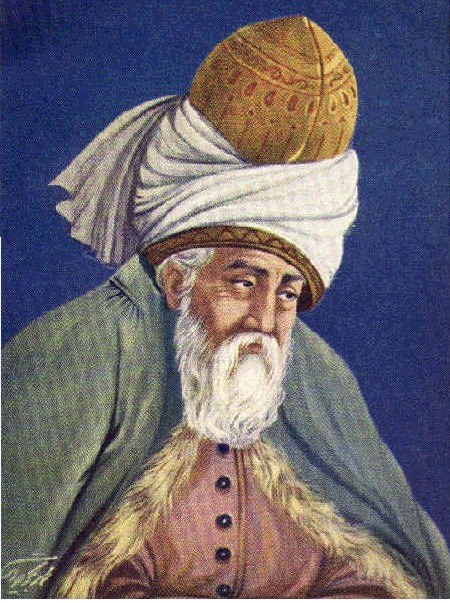
Dance... by Rumi

I bought a book of poems by Rumi last spring, and really loved them. I have done more scanning of the book than anything. My parents and I went camping for Labor Day weekend this fall, and I found a poem in the book that weekend that quickly became my favorite Rumi poem (and possibly all-time favorite poem). It became my mantra for the semester, and I feel like I have lived out each stanza, or at least tried my hardest to do so. Anyway, here is the poem that saved me and my sanity this semester:

Dance, when you're broken open.
Dance, if you've torn the bandage off.
Dance in the middle of the fighting.
Dance in your blood.
Dance, when you're perfectly free.

-Rumi

Monday, December 15, 2008

A New Beginning

"Every new beginning comes from some other beginning's end." -Semisonic, Closing Time

I find this lyric from the song Closing Time quite appropriate for my life right now. Saturday I graduate from Drury with my undergrad degree in religion (and minor in Middle East Studies). I can't even believe that 3 1/2 years have already gone by. Part of me feels like I'm still 17 or 18 year old fairly naive Latesa, but then again I feel like a completely different person than I was when I graduated from high school. Well, I am a totally different person. I actually don't even recognize the girl who came to Drury as a little freshmen. Life experiences in general have a way of changing you forever.

I can't even process the fact that I'm graduating and that this week is my last week ever at Drury. Of course I will still hang out with the girls frequently, but it won't be my "home" anymore. I'm just overwhelmed with feelings of sadness, nostalgia, anxiety, and a little happiness and excitement as well. I do not feel old enough to be out in the "real world" at all. I feel like I didn't apply myself nearly enough in my classes or push myself to my full potential. I know I didn't, in fact, and I regret that now. There's so much more I could have learned if I would have actually pushed myself. Thankfully/Hopefully I will be able to put off official real world-ness (yes that's a word) for a while because I plan on going to graduate school next fall. Until then, however, I must work, and I might be working full time. Money-wise that will be great, but if I get this one job I will be forced to live a lie. I'm comfortable with that for the most part, but I still have pangs of guilt when I think about it. *shrug* I don't have the job yet, so we'll see what happens.

Anyway, as I am enjoying my last few days as a Drury student, I am reminded of the people at Drury who have been my best friends, challenged me, and been there for me when I needed them the most.

Lindsey Castrodale: She was my first friend at Drury and lived in the room diagonal from mine in Wallace (affectionately called Wall-ass). She is beautiful inside and out. The last couple years have been difficult for us to keep in touch on a regular basis, but we have such a good foundation that it doesn't matter. I love that we can always pick up where we left off, and we will be there for each other at a moments notice if needed. We always have fun: being goofy, serious, girly, and OCD. I love her so so so much.


Forrest Schaeffer: Forrest and I have also been friends since I moved into Wallace. He has always been one of my closest friends, and when he moved away to KU, our friendship strengthened so much. He is one of my best friends, and I love that we can have intellectual conversations, inappropriate conversations, nerdy conversations, serious conversations, and goofy conversations. I just can't imagine what the last 4 years would have been like without his friendship.

Marie Tracy: We met in Alpha and were decent friends. We really bonded in Intro to Religion with our bitching, and then in the last year she has become one of my best friends. We understand each other so well. In fact, I relate to her better than anyone I know in some regards. She can always make me smile. I love talking to her about serious things because she gives me good advice. I love busting into song with her constantly, especially our fave Britney. I love when we're being bitches together or when we both laugh our obnoxious high pitched laugh. Basically, I love this woman more than I can sum up in a concise matter and cannot fathom my life without her in it.


Ashley Morris: I don't even know where to begin with this woman. We became good friends right after winter break freshmen year. Through classes we were able to keep in touch on a regular basis, and then our friendship grew outside of the classroom. She has been there for me through everything: when I was falling apart or on top of the world. We ponder about religion and philosophy, we talk about painful memories, we laugh about our shenannigans, we have fun together, we bitch about everything, give advice, and offer a shoulder to lean on or cry on. The Mudlounge is our favorite place to catch up or get a drink, or 5. She is the first person who taught me what a real friend is, and I only wish I'm half as good of a friend to her as she is to me. I love her SO much; she means the world to me. I am so thankful for her love and friendship. I know without a doubt, I would not be who I am or where I am now if it wasn't for her, and for that I am eternally thankful.

Sunday, November 30, 2008

Dance Practice

For so long I've been searching,
Looking for the right dance partner,
One whose movements I can always predict,
Whose body moves rhythmically with mine,
Who twirls me around until I'm dizzy,
Who catches me when I dip low,
And who lifts me high above.
I long for the intimacy,
The passion,
The support and security,
And the comfort which accompanies perfect chemistry.
I've tried out a partner, or ten.
We danced a few dances: the tango, a waltz.
But every partner dropped me from a lift,
Or twirled me around and around, never steadying my balance.
We got out of step, lost our rhythm.
Frantically I looked for a new partner each time
Meanwhile I failed to notice how rigid my own movements became
Or how my feet began struggling to find the beat
I looked in the mirror while dancing with my last partner and
saw a girl who needed some practice
Alone--just her and the mirror
I finally found freedom and joy when I was
Dancing,
Dancing alone,
Dancing in my blood.

Tuesday, November 25, 2008

To Know Me is to Love Me...ish

This is supposed to be a note thing on facebook, but I don't do facebook notes. I have some time to kill so I figured I would write up some random facts about myself.
The chain thing says we have to write a note with 16 random things, shortcomings, facts, habits or goals about you. So here goes:

1. Borders (the bookstore, of course) is my sanctuary in the true definition of the word. Seriously. I find refuge and peace there.

2. I sleep with a teddy bear every night and have slept with one (or a stuffed animal of some sort) since I was really young.

3. I don't admit to it much anymore, but my dad is still my hero.

4. Right now I find it difficult to believe in God or a divine being, but I always find my faith when I am in nature.

5. I love to cook. If I've had a bad day, it isn't atypical for me to cook up a nice meal as a form of therapy.

6. Four words: Oh my God! Shoes!

7. I judge guys based on their nerdiness. If they don't meet my qualifications for my minimum desire for nerdiness, then they are immediately disqualified.

8. My life has a soundtrack. There is a song for nearly every major event of my life, especially the difficult ones.

9. My dogs mean more to me than almost anything else. If you are mean to my dogs, I will never forgive you.

10. When people first get to know me, they know there's a lot more to me than I give off or even say. They have no idea just how much there is to me.

11. I really do want to change the world. No bullshit or idealistic talk.

12. I'm a little bit OCD when it comes to things like chalk, newspapers, alphabetizing, germs, and handrails.

13. The only effective punishment my parents had for me when I was younger was to ground me from reading (because of reading too much).

14. I find joy in the simple things in life, like laughter/smiles, flowers(!), sunsets, the right song at the right time, etc.

15. I hate wearing jeans. The second I get home, I change into sweats. However, I never ever wear sweats or pajama pants anywhere besides my house or my friends' apartments.

16. I'm leaving to go camping for Thanksgiving.

Happy Thanksgiving all!

Wednesday, July 2, 2008

Ignorant Embryos


During the spring I bought a collection of Rumi poems, and I adore them. I thought I would post one of the poems I really like.

Wean Yourself

Little by little, wean yourself.
This is the gist of what I have to say.
From an embryo, whose nourishment comes in the blood,
move to an infant drinking milk,
to a child on solid food,
to a searcher after wisdom,
to a hunter of a more invisible game.

Think how it is to have a conversation with an embryo.
You might say, "The world outside is vast and intricate.
There are wheatfields and mountain passes,
and orchards in bloom.

At night there are millions of galaxies, and in sunlight
the beauty of friends dancing at a wedding."

You ask the embryo why he, or she, stays cooped up
in the dark with eyes closed.
Listen to the answer.

There is no "other world."
I only know what I've experience.
You must be hallucinating.


As I try to figure out just what I believe, I find myself coming back to this poem. It tells me that there is still a great mystery in this world that I do not understand. How do I know that the world I see and experience is all that there is? Also, how do I know that it isn't? Perhaps we humans are like the embryo in the poem calling those who have had a spiritual experience crazy. Maybe they are. But, then again, maybe we are just ignorant. Through this, Rumi is arguing that there is a divine presence. I do believe that there is a mystery, and I like that. I'm still figuring out the whole "God" thing, but I would like to believe there is one looking over us conducting the great orchestra of life and this universe.

Friday, April 4, 2008

Aquinas on Virtue


A couple weeks ago in my Christian Ethics class we were talking about Thomas Aquinas. We were [obviously] looking at his position on ethics, which I found very interesting. Aquinas believed virtue was determined by habit not by decisions made in "exceptional circumstances." Towards the end of class Dr. Browning just talked to our class, and it was a really cool moment. He just asked us to reflect on our own habits, those we think show a virtuous character as well as those we would like to change. The mood changed to a very somber and reflective mood.

After learning about Aquinas' position on virtue, I found myself agreeing with him. For a paper on the history and development of Christian ethics I wrote a section about Aquinas. Here's some of it:

“Thomas defines virtue as a ‘good quality of the mind, by which we live righteously, of which no one can make bad use, which God works in us without us.’ Virtue, he continues, ‘is a habit which is always referred to good.’ We may say, then, that virtue is a habit or disposition of the will toward a good end” (Wogaman 86). The definition of virtue is the central component to Aquinas’ Christian ethic.

The development of a virtuous life, according to Aquinas, is determined by the development of habits. Developing good, virtuous, godly habits will lead to an ethical life. He believes that living a moral life is not determined by the major decisions individuals must face, but it is about being a certain kind of person. Exceptional circumstances, which today could include the decision about having an abortion or allowing physician assisted suicide, do not make one moral or immoral. It is the habits individuals develop which determine whether they are virtuous or not.

From Aquinas I personally get the most meaning. His idea that virtue is a habit to be developed overtime, not in crisis moments, is profound I believe. I agree that someone’s morality should not be determined based on a decision they made in a crisis moment. The most applicable example I can think of is that a young unmarried couple should not be viewed as immoral and ostracized for having an abortion, which the Church overall sees as being ethically wrong for Christians. Instead, the way the young man and woman live their lives everyday should be the measuring tool for determining their morality.

In exceptional circumstances, people ask “What can I do?” Aquinas instead suggests daily we ask ourselves, “What kind of person should I be?”