Wednesday, July 2, 2008

Ignorant Embryos


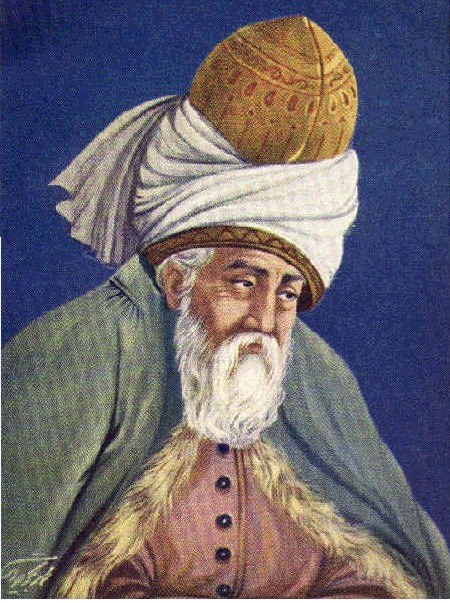
During the spring I bought a collection of Rumi poems, and I adore them. I thought I would post one of the poems I really like.

Wean Yourself

Little by little, wean yourself.
This is the gist of what I have to say.
From an embryo, whose nourishment comes in the blood,
move to an infant drinking milk,
to a child on solid food,
to a searcher after wisdom,
to a hunter of a more invisible game.

Think how it is to have a conversation with an embryo.
You might say, "The world outside is vast and intricate.
There are wheatfields and mountain passes,
and orchards in bloom.

At night there are millions of galaxies, and in sunlight
the beauty of friends dancing at a wedding."

You ask the embryo why he, or she, stays cooped up
in the dark with eyes closed.
Listen to the answer.

There is no "other world."
I only know what I've experience.
You must be hallucinating.


As I try to figure out just what I believe, I find myself coming back to this poem. It tells me that there is still a great mystery in this world that I do not understand. How do I know that the world I see and experience is all that there is? Also, how do I know that it isn't? Perhaps we humans are like the embryo in the poem calling those who have had a spiritual experience crazy. Maybe they are. But, then again, maybe we are just ignorant. Through this, Rumi is arguing that there is a divine presence. I do believe that there is a mystery, and I like that. I'm still figuring out the whole "God" thing, but I would like to believe there is one looking over us conducting the great orchestra of life and this universe.

Friday, April 4, 2008

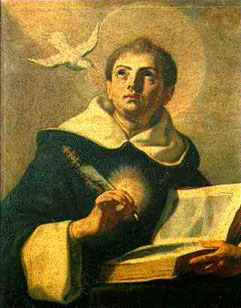
Aquinas on Virtue


A couple weeks ago in my Christian Ethics class we were talking about Thomas Aquinas. We were [obviously] looking at his position on ethics, which I found very interesting. Aquinas believed virtue was determined by habit not by decisions made in "exceptional circumstances." Towards the end of class Dr. Browning just talked to our class, and it was a really cool moment. He just asked us to reflect on our own habits, those we think show a virtuous character as well as those we would like to change. The mood changed to a very somber and reflective mood.

After learning about Aquinas' position on virtue, I found myself agreeing with him. For a paper on the history and development of Christian ethics I wrote a section about Aquinas. Here's some of it:

“Thomas defines virtue as a ‘good quality of the mind, by which we live righteously, of which no one can make bad use, which God works in us without us.’ Virtue, he continues, ‘is a habit which is always referred to good.’ We may say, then, that virtue is a habit or disposition of the will toward a good end” (Wogaman 86). The definition of virtue is the central component to Aquinas’ Christian ethic.

The development of a virtuous life, according to Aquinas, is determined by the development of habits. Developing good, virtuous, godly habits will lead to an ethical life. He believes that living a moral life is not determined by the major decisions individuals must face, but it is about being a certain kind of person. Exceptional circumstances, which today could include the decision about having an abortion or allowing physician assisted suicide, do not make one moral or immoral. It is the habits individuals develop which determine whether they are virtuous or not.

From Aquinas I personally get the most meaning. His idea that virtue is a habit to be developed overtime, not in crisis moments, is profound I believe. I agree that someone’s morality should not be determined based on a decision they made in a crisis moment. The most applicable example I can think of is that a young unmarried couple should not be viewed as immoral and ostracized for having an abortion, which the Church overall sees as being ethically wrong for Christians. Instead, the way the young man and woman live their lives everyday should be the measuring tool for determining their morality.

In exceptional circumstances, people ask “What can I do?” Aquinas instead suggests daily we ask ourselves, “What kind of person should I be?”

Tuesday, November 27, 2007

Song of Silence

I decided I want to put up a poem I wrote over Thanksgiving break. Before I put it up I need to give the story behind it so hopefully it will make the poem more meaningful to those of you who read it.

Summer 2006 I had the amazing opportunity to go to Israel and the West Bank. While I was in the West Bank (Palestine), I stayed in Bethlehem. The group I went with visited a non-profit organization there in Bethlehem called the House of Hope. This building provides education, work, and a social environment for blind adults and children with physical/mental disabilities. There were several children there. One girl in particular captured my attention. She just kept staring at me with her big brown eyes. Her eyes literally danced and lit up her face, and then she would just sit and smile. Her smile was so beautiful. She literally had me mesmerized by the joy in her face. She didn't have down syndrome or any obvious handicaps, so I wondered why she was there. Later I learned her story, and it broke my heart.

When she was a little girl (still a toddler I believe), the Israeli soldiers burst into her house kicking her and her family out. The soldiers startled her and scared her so she tried to run away from them. While she was trying to get away she fell and hit her head. Her fall caused her to not be able to speak again.

I found the picture I took of her and it inspired me to write this poem. Here are two pictures of her.


"Song of Silence: from a بنت جميلة"
(transliteration from Arabic: biint jamila. translation: beautiful girl)

Little girl
My soul is heavy for you tonight.
Your deep brown eyes dancing with light
Caught my gaze.
As our eyes met you
Captured my heart.
I can see your beautiful smile stretching across your
Brown face and your
Free spirit shining through.
Words to share escape me even before I
Understand that oppressors
Stole your song and
Caged you.
They took the key and left you a
Victim
Forever bearing the scar of this punishment given for a
Crime you never committed.
In spite of your suffering, you didn't stop
Smiling and as you smiled I could
Hear the lyrics of the
Beautiful song you were
Singing even though the oppressors took your
Words.